
SME Meaning in BPO: What This Role Does and Why It Matters
An SME in BPO stands for Subject Matter Expert, a senior-level resource person who holds deep, specialized knowledge about a specific process, product, or client account. In Philippine call centers and outsourcing firms, SMEs are the go-to professionals who bridge the gap between frontline agents and management.
Key Takeaways
- SME stands for Subject Matter Expert, not a small business classification in the BPO context.
- SMEs are knowledge anchors who support agents, trainers, and quality teams simultaneously.
- The role is a recognized career growth path in Philippine BPO companies, often leading to training or operations management.
- SMEs influence key performance indicators like Average Handle Time, First Call Resolution, and CSAT scores.
- Becoming an SME requires a combination of tenure, product mastery, and demonstrated communication skills.
- Philippine BPO firms often use SMEs during nesting periods, new product launches, and escalation handling.
Table of Contents
What an SME Actually Does in a BPO Setting
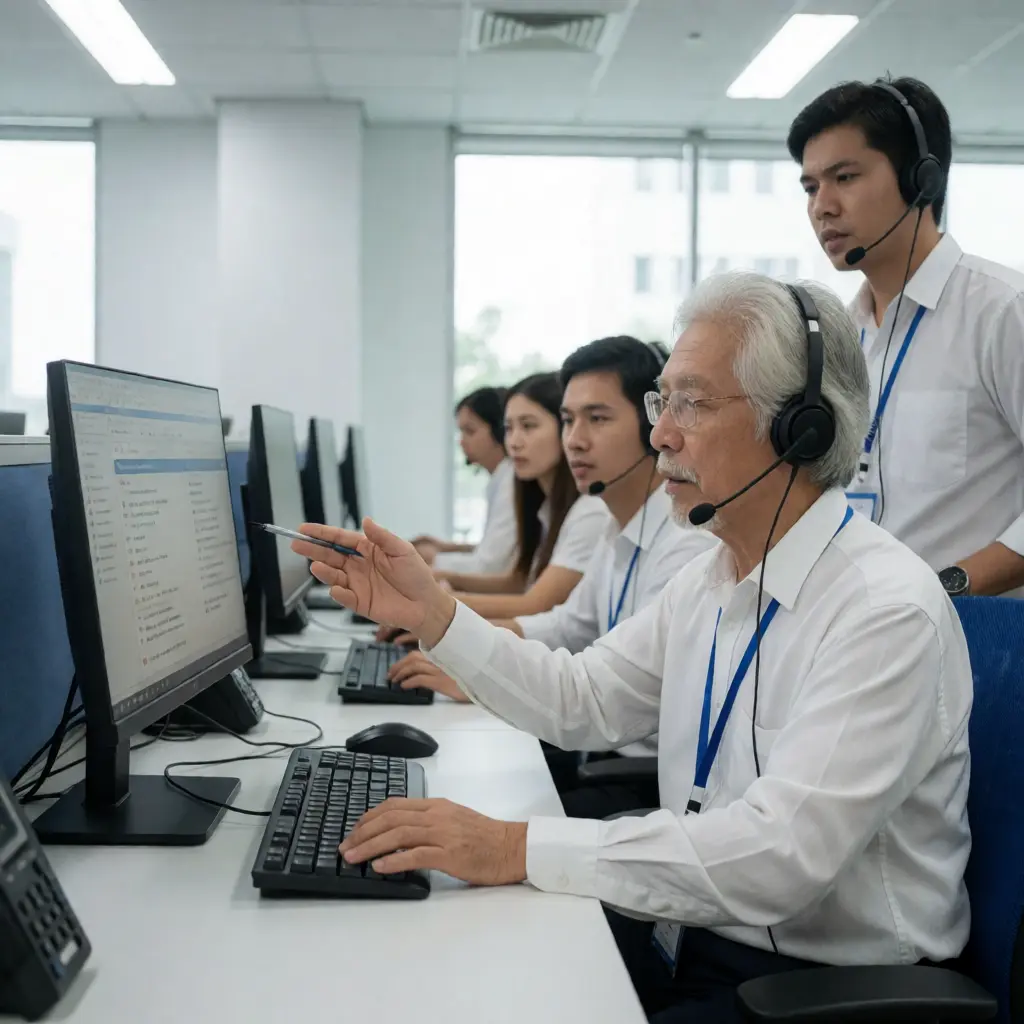
The sme meaning in bpo goes beyond just knowing the product well. An SME serves as a live reference point for the entire team during operations. When agents encounter unusual scenarios, complex client requests, or policy gray areas, they consult the SME before escalating the call or submitting an incorrect resolution.
Here is a breakdown of the core responsibilities most Philippine BPO companies assign to their SMEs:
Day-to-Day Functions:
- Floor support: SMEs walk the production floor during live operations, answering agent questions in real time without pulling agents off the phone.
- Knowledge base updates: They review and update process documentation whenever the client issues changes, new policies, or product revisions.
- Nesting support: During nesting (the period when newly trained agents take live calls under supervision), SMEs are stationed nearby to catch errors before they reach the customer.
- Escalation handling: Some accounts route escalated calls directly to the SME when a supervisor is unavailable or when the issue is purely technical or process-related.
- Calibration participation: SMEs join quality calibration sessions to align on how specific scenarios should be handled, ensuring consistency across the team.
- Training assistance: While not always a full trainer, an SME frequently co-facilitates refresher training, new hire certification, or product update rollouts.
What separates an SME from a regular senior agent is accountability. An SME is held responsible for the accuracy of information circulating on the floor. If agents are consistently making the same mistake, the SME is usually the first person asked to correct it.
SME vs. Other BPO Roles: Understanding the Difference
There is frequent confusion between the SME and other support roles in a BPO organizational chart. The table below clarifies the distinctions across the most common positions in Philippine outsourcing companies.
| Role | Primary Focus | Reports To | Manages Agents? |
|---|---|---|---|
| Agent | Customer interaction | Team Leader | No |
| Senior Agent | Complex calls + coaching peers | Team Leader | No |
| SME | Process knowledge + floor support | Operations / Training | No (influence only) |
| Team Leader (TL) | Performance management | Operations Manager | Yes |
| Trainer | Initial and ongoing training | Training Manager | No |
| Quality Analyst (QA) | Call monitoring + scoring | QA Manager | No |
Notice that the SME does not have direct authority over agents but carries significant influence. This makes the role particularly challenging because an SME must earn credibility through expertise rather than positional power. In many Philippine BPO companies like Concentrix, Teleperformance, and Convergys (now Concentrix), the SME role sits within the operations track but works closely with the training and quality departments.
Why SMEs Are Critical to BPO Performance Metrics
Understanding the sme meaning in bpo is incomplete without looking at the numbers. SMEs have a direct impact on the key performance indicators (KPIs) that BPO clients track and that determine whether a contract gets renewed.
First Call Resolution (FCR): When agents have quick access to accurate process knowledge through an SME, they resolve customer issues without requiring a callback. Philippine BPO benchmark data consistently shows that accounts with active SME floor support tend to have higher FCR rates because agents do not make guesses.
Average Handle Time (AHT): An agent who is unsure about a procedure spends extra time on hold looking for answers. An available SME shortens that hold time significantly. The Philippine IT-BPO industry, which contributed approximately $32.5 billion in revenue in 2023 according to the IT and Business Process Association of the Philippines (IBPAP), operates on razor-thin margins where every second of AHT matters.
Customer Satisfaction (CSAT): Customers notice when an agent hesitates or provides inconsistent information. Having an SME available reduces those inconsistencies. Accounts with structured SME support programs report fewer complaints tied to incorrect information.
Agent Attrition: This one is less obvious but equally important. Agents who feel supported and have clear answers available tend to be less stressed. Reduced stress contributes to lower attrition, which is a persistent challenge in the Philippine BPO industry. The average annual attrition rate in Philippine call centers ranges from 30% to 60%, and SME programs are one of the operational strategies used to improve agent confidence and retention.
How to Become an SME in a Philippine BPO Company
The path to becoming an SME varies by company, but there are consistent patterns across the industry. Most Philippine BPO firms do not advertise SME openings the same way they post agent vacancies. Instead, they identify candidates internally based on performance and behavior.
Typical Requirements:
- Minimum tenure of 6 to 12 months on the same account, depending on complexity
- Consistent performance scores at or above team average (usually top 20% to 30%)
- Strong quality scores with low error rates on process adherence
- Demonstrated ability to explain procedures clearly to peers
- No active disciplinary actions on record
- Willingness to work flexible schedules, including during training cycles or new product launches
The Selection Process:
Most companies use a combination of written assessments, panel interviews, and mock floor support scenarios. Candidates are evaluated on how accurately they recall process details, how calmly they handle pressure, and how clearly they communicate with agents who may be frustrated or confused.
Once selected, new SMEs typically go through an SME certification program that covers knowledge base navigation, escalation protocols, documentation practices, and communication techniques for floor support.

Compensation and Career Growth for BPOs SMEs in the Philippines
One of the most practical questions about this role is what it pays. SME salaries in Philippine BPO companies vary based on the account complexity, the company size, and the location (Metro Manila vs. provincial sites).
Estimated Monthly Salary Ranges (as of 2024):
| Experience Level | Estimated Monthly Salary (PHP) |
|---|---|
| Junior SME (less than 1 year in role) | ₱25,000 to ₱35,000 |
| Mid-level SME (1 to 2 years in role) | ₱35,000 to ₱45,000 |
| Senior SME / SME Lead (2+ years) | ₱45,000 to ₱60,000 |
These figures are approximate and depend heavily on the account type. Technical support accounts, healthcare BPO accounts, and financial services accounts tend to offer higher SME compensation than general customer service accounts because the knowledge requirements are more demanding.
Beyond compensation, the SME role is a recognized stepping stone in the Philippine BPO career ladder. Common next positions after SME include:
- Training Specialist or Trainer: Leveraging knowledge skills to facilitate full training classes
- Quality Analyst: Applying process expertise to evaluate agent calls
- Team Leader: Moving into a supervisory track with direct reports
- Process Improvement Analyst: Working on workflow optimization, often transitioning to a corporate or client-facing role
Things to Know
- The title “SME” is sometimes used interchangeably with “Process Expert” or “Knowledge Expert” depending on the company, but the function is essentially the same.
- Not all SME roles include a formal salary increase. In some companies, the SME designation is a stepping stone role with only a small allowance or recognition benefit. Clarify compensation terms before accepting.
- Philippine labor law under the DOLE governs proper job reclassification. If your duties have materially changed (as an SME often entails significantly more responsibility), you may be entitled to role reclassification and corresponding pay adjustment under RA 6727 and related wage orders.
- SMEs on shifting schedules in Philippine BPO companies are entitled to night differential pay (10% of hourly rate for hours worked between 10 PM and 6 AM) under the Labor Code of the Philippines.
- Some accounts rotate the SME role among senior agents rather than assigning it permanently. This is more common in smaller accounts with limited headcount.
- If you are currently an SME without formal documentation of your role and responsibilities, request a Job Description from HR. This protects you during performance reviews and ensures your contributions are formally recognized.

Ready to Step Into the SME Role?
If you are currently a senior agent or high-performing agent on your account, the most actionable step you can take right now is to document your process knowledge. Start building your own reference sheets for the most common scenarios your team handles, including edge cases and escalation triggers. This exercise alone demonstrates SME-level thinking and positions you as an obvious candidate when your Team Leader or Operations Manager looks for someone to fill the role.
Approach your TL or direct supervisor and ask specifically about SME openings or nomination cycles on your account. Most Philippine BPO companies run these cycles quarterly or during major account transitions, so timing your conversation with those periods increases your chances.
Frequently Asked Questions
Q: Is SME the same as a Team Leader in BPO?
No, an SME and a Team Leader are different roles with different responsibilities.
A Team Leader directly manages agents, handles performance reviews, and has formal authority over the team. An SME is a knowledge resource without direct supervisory authority, focused on process accuracy and floor support rather than people management.
Q: Can an SME handle customer calls, or is it purely a support role?
SMEs in most Philippine BPO accounts do handle customer calls, particularly escalations, though the volume is lower than regular agents.
Some accounts require SMEs to maintain a portion of their time on the phone to stay current with real customer scenarios. This prevents knowledge drift and keeps the SME grounded in actual agent and customer experience.
Q: How long does it typically take to become an SME in a Philippine BPO?
Most candidates qualify for SME consideration after 6 to 18 months on the same account, depending on the company’s internal policy.
Tenure alone is not enough. Consistent quality scores, product knowledge assessments, and peer feedback also factor into the selection process. Some complex accounts like healthcare or legal BPO require even longer track records.
Q: Does being an SME guarantee a promotion to Team Leader?
Being an SME does not guarantee a Team Leader promotion, but it is a recognized path toward leadership in most Philippine BPO companies.
SMEs who develop coaching and communication skills alongside their process expertise are stronger candidates for leadership roles. Many successful Team Leaders and Training Managers in the Philippine BPO industry came through the SME track.
Q: What is the difference between an SME and a Quality Analyst in BPO?
An SME focuses on sharing knowledge and supporting agents in real time, while a Quality Analyst evaluates recorded or live calls against defined standards.
Both roles work with process accuracy, but the SME is proactive (preventing errors before they happen) while the QA is reactive (identifying errors after they occur). In some smaller accounts, one person may fill both functions, but larger operations keep these roles separate for objectivity.
The Bottom Line on SME Meaning in BPO
The sme meaning in bpo is straightforward at the surface level but deeply practical in its application. An SME is the person who keeps process knowledge alive and accurate on the production floor, directly influencing how well agents perform and how satisfied customers are at the end of each interaction.
For professionals building a career in the Philippine BPO industry, the SME role is one of the most valuable positions to pursue before moving into training, quality, or operations management. It builds credibility, expands your understanding of the entire operation, and positions you as someone who makes the whole team better. Start by mastering your current account inside out, and the path to becoming an SME will open naturally from there.