
Ask for Receipt BIR: Complete Guide to NIRI, Templates, Rules & Penalties
Transparency in business transactions is a cornerstone of the Philippine tax system. For decades, the familiar orange “Ask for Receipt” sign reminded consumers to demand official documentation. Today, that system has evolved into a more modern framework under the Bureau of Internal Revenue (BIR).
If you’re a business owner, freelancer, online seller, or professional in the Philippines, this guide explains everything you need to know about:
- Ask for Receipt BIR rules
- The new Notice to Issue Receipt/Invoice (NIRI)
- Templates and display requirements
- Tax mapping penalties
- Compliance under the Ease of Paying Taxes Act
Table of Contents
Ask for Receipt BIR: What It Means Today
The ask for receipt BIR policy originated under Revenue Regulations No. 04-2000 and was later standardized by RR No. 07-2005. Businesses were required to display the orange “Ask for Receipt” Notice (ARN) to encourage consumers to request official receipts.
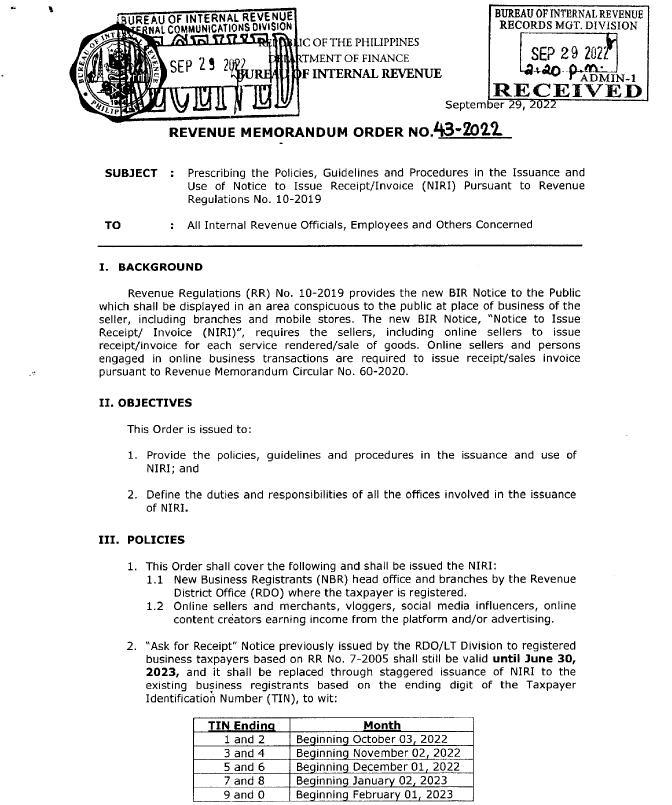
However, under Revenue Regulations No. 10-2019 and Revenue Memorandum Order No. 43-2022, the old orange sign was replaced by the green:
Notice to Issue Receipt/Invoice (NIRI)
The transition officially ended on September 30, 2023. All businesses must now display the green NIRI.
Key Differences: Old vs. New System
| Feature | Old Ask for Receipt Notice | New NIRI |
|---|---|---|
| Color | Orange | Green |
| Information | Generic reminder | Contains business name, address & TIN |
| Scope | Mostly physical stores | Includes online sellers & digital businesses |
| Validity | Expired Sept 30, 2023 | Currently valid |
The NIRI strengthens compliance by including taxpayer-specific details and digital reporting channels.
BIR Ask for Receipt: Legal Basis and Updated Rules
When people search for “bir ask for receipt”, they usually want to know:
- Is it still required?
- Where should it be posted?
- What happens if I don’t display it?
Under RR No. 10-2019 and RMO No. 43-2022:
✔ All registered businesses must display the green NIRI
✔ It must be BIR-issued (no photocopies allowed)
✔ It must be visible at the point of sale
✔ Online businesses must display it digitally
Revenue officers verify this during Tax Compliance Verification Drives (Tax Mapping).
Failure to display the NIRI results in a ₱1,000 administrative fine.
Ask for Receipt: Why It Still Matters Today
Even though the signage changed, the principle remains:
Consumers must always be issued an Invoice for every sale.
Under Republic Act No. 11976 or the Ease of Paying Taxes (EOPT) Act, effective January 22, 2024:
- The distinction between Sales Invoice (SI) and Official Receipt (OR) has been removed.
- All sales (goods and services) must now be evidenced by an Invoice.
- VAT reporting is now accrual-based for everyone.
Updated Invoice Threshold
- Mandatory issuance threshold increased from ₱100 to ₱500
- BUT if a customer requests an invoice, it must be issued regardless of amount.
This strengthens the purpose of the “Ask for Receipt” campaign — empowering consumers to demand proper documentation.
Ask for Receipt BIR Template (Old vs. New NIRI Format)
Many business owners search for an ask for receipt BIR template. However, important reminder:
The NIRI must be issued by the BIR. You cannot create your own version.
What the Official NIRI Contains:
- “ASK FOR A RECEIPT” in bold letters
- Business Name
- Registered Address
- TIN
- Reporting channels (eComplaint, chatbot Revie)
- Legal warning on non-issuance
Old Orange Ask for Receipt Notice (Legacy)

New Green Notice to Issue Receipt/Invoice (NIRI)

If you need the official version, request it from your Revenue District Office (RDO) after updating your registration.
Ask for Receipt Notice: Proper Placement Requirements
The ask for receipt notice must be “conspicuously displayed.”
Here are the updated placement rules:
| Business Type | Placement Requirement |
|---|---|
| Single-counter store | Near cash register |
| Multi-counter store | At every cashier station |
| Online seller | On website or social media page |
| Professional office | Reception/payment area |
| Mobile stall | Visible at transaction point |
During tax mapping, BIR officers check:
- NIRI signage
- Certificate of Registration (Form 2303)
- Authority to Print (ATP)
- Books of Accounts
- CRM/POS stickers
Penalties for Non-Compliance
Failure to follow invoicing rules can lead to serious penalties:
| Violation | Penalty |
|---|---|
| No NIRI displayed | ₱1,000 |
| Failure to issue invoice | ₱10,000 (1st offense) |
| Refusal to issue invoice | ₱25,000 (1st offense) |
| Use of unregistered receipts | ₱10,000–₱20,000 |
| Failure to register business | ₱5,000–₱20,000 + possible imprisonment |
Repeat or serious violations may result in:
- Criminal charges under Section 264 of the Tax Code
- Business closure under Oplan Kandado
Official Email Requirement Under NIRI
One of the biggest changes under RMO 43-2022:
All business taxpayers must designate an official company email address.
To update:
- File BIR Form 1905
- Or update through ORUS
The BIR will use this email to serve:
- Notices
- Audit letters
- Assessment orders
- Compliance reminders
Missing an email notice may mean missing a legal deadline.
Digital Reporting: How Customers Can Report Violations
The NIRI encourages public reporting through:
- eComplaint NO OR (non-issuance of invoice)
- eComplaint RATE (tax evasion)
- eComplaint OTHERS (missing signage)
- Chatbot Revie
Reports are acknowledged within 24 hours, with action within 72 hours.
This makes the “Ask for Receipt” campaign a public accountability tool.
Future Outlook: Electronic Invoicing System (EIS)
The BIR is rolling out the Electronic Invoicing System (EIS).
Target:
All VAT-registered taxpayers integrated by December 31, 2026.
Under EIS:
- Invoices will be digitally generated
- Reported to BIR in near real-time
- Traditional manual receipts may eventually disappear
The green NIRI is considered a transitional step toward full digital compliance.
Final Compliance Checklist for Business Owners
To stay compliant:
✔ Display the green NIRI at every point of sale
✔ Issue an Invoice for every transaction
✔ Convert old Official Receipts properly (if applicable)
✔ Update your official company email
✔ Train staff to always issue invoices
✔ Monitor email for BIR notices
Conclusion
The evolution from the orange Ask for Receipt BIR sign to the green Notice to Issue Receipt/Invoice (NIRI) reflects the Philippine government’s push toward transparency and digital transformation.
For businesses, compliance is no longer optional — it is strategic. Proper invoicing:
- Protects you from penalties
- Builds customer trust
- Ensures VAT claims are valid
- Prevents closure under tax mapping
As the BIR moves toward full electronic invoicing by 2026, businesses that adapt early will have a competitive advantage in a more transparent and digitally connected tax environment.