

The Complete Guide to Barangay Business Permits in the Philippines: Requirements, Costs & Process
Starting a business in the Philippines? Whether you’re launching a sari-sari store, a home-based online shop, or a formal enterprise, securing a barangay business permit is the first step toward legal operation. This document proves that your business is recognized and approved by your local barangay—a requirement before you can obtain a Mayor’s Permit or register with the BIR.
But what is a barangay business permit, exactly? How much does it cost? What are the requirements? This guide breaks down everything you need to know—from fees and application steps to downloadable samples and city-specific rules. If you’re wondering magkano ang barangay business permit, how to renew it, or whether it’s enough on its own—this article has the answers.
Table of Contents
What is a Barangay Business Permit?
A Barangay Business Permit, also known as a Barangay Clearance for Business, is a mandatory document issued by the local barangay office that grants a business permission to operate within its jurisdiction.
Barangay business permit definition: It is an official certification confirming that a business has secured community-level approval and is compliant with local ordinances, zoning regulations, and community tax obligations.
Importance of Barangay Business Permit
The importance of barangay business permit lies in its role as the first step in the legal registration of any enterprise in the Philippines. Whether you’re operating a sari-sari store, freelancing from home, or starting a corporation, this permit:
- Proves compliance with local barangay ordinances
- Is required for obtaining a Mayor’s Permit
- Helps track businesses for community tax purposes
- Ensures neighborhood safety, peace, and order through local vetting
The barangay permit is not a standalone license. It is part of a broader legal requirement that includes municipal/city permits, BIR registration, and industry-specific compliance. Without it, you cannot proceed to the next stages of business registration.
✅ In short, what is a barangay business permit? It’s the barangay’s way of saying: “You’re allowed to do business here—but follow the rules.”
Barangay Business Permit Requirements
Before applying, you must prepare all the necessary barangay permit requirements for business. Below is a comprehensive checklist covering both new applications and renewals, ensuring your business stays compliant.
List of Requirements for Barangay Clearance for Business Permit (New Applications)
Here is the standard list of requirements for barangay clearance for business permit:
- ✅ Accomplished Barangay Business Permit Application Form
- ✅ Valid government-issued ID of the business owner
- ✅ DTI Business Name Certificate (for sole proprietors) or SEC Registration (for partnerships/corporations)
- ✅ Lease contract or proof of property ownership (if applicable)
- ✅ Sketch or map of business location
- ✅ Community Tax Certificate (CTC or Cedula)
- ✅ Sanitary permit (varies by business type and LGU)
- ✅ Other permits depending on the nature of your business (e.g., fire safety, health clearance)
Note: Some barangays may have additional requirements or forms. It’s best to visit your local barangay office for the latest list.
Requirements for Renewal of Barangay Business Permit
Planning to renew your clearance? Here’s a quick list of requirements for renewal of barangay business permit:
- ✅ Previous year’s Barangay Business Permit (photocopy and original for verification)
- ✅ Updated DTI/SEC registration (if renewed)
- ✅ Updated lease contract (if applicable)
- ✅ Community Tax Certificate for the current year
- ✅ Accomplished renewal form from the barangay
- ✅ Payment of applicable barangay business permit fee
Requirements sa Pagkuha ng Barangay Business Permit
In Filipino:
“Ano ang mga requirements sa pagkuha ng barangay business permit?”
Ito ay karaniwang kinabibilangan ng DTI o SEC registration, ID, CTC, lease contract, at form na galing sa barangay. Magkaiba-iba ang dokumentong hinihingi depende sa barangay, kaya siguraduhing i-check sa opisina ng barangay ninyo.
Requirements vary by barangay or city. Always check for updated guidelines from your local office to avoid delays.
Barangay Business Permit Fees
One of the most common questions from first-time business owners is: How much is barangay business permit? The answer depends on several factors—including the type and size of your business, and your location.
Cost of Barangay Business Permit
Here’s a typical breakdown of the barangay business permit fee structure:
| Fee Component | Estimated Cost (₱) |
|---|---|
| Base application fee | ₱200 – ₱500 |
| Community Tax Certificate (CTC) | ₱100 – ₱300 |
| Documentary stamp or processing fee | ₱50 – ₱100 |
| Additional fees (based on business) | ₱100 – ₱1,000+ |
Magkano ang barangay business permit?
On average, expect to pay between ₱300 to ₱1,500 for a small business, depending on your barangay.
Sari-Sari Store vs. Larger Business: Sample Fee Comparison
| Business Type | Estimated Barangay Permit Cost |
|---|---|
| Sari-Sari Store | ₱300 – ₱600 |
| Small Online Seller | ₱400 – ₱800 |
| Food Stall or Kiosk | ₱500 – ₱1,000 |
| Retail Store (Brick & Mortar) | ₱800 – ₱1,500+ |
| Corporation / Office | ₱1,000 – ₱2,000+ |
These are estimates only. Barangay permit fees may be higher in cities like Quezon City, Manila, or Taguig, and lower in rural areas.
Note: Fees Vary by Barangay
Each barangay sets its own fee schedule through local ordinances. Some barangays include additional charges based on:
- Type of goods/services offered
- Square meters of business space
- Number of employees
Always verify the official fee schedule with your barangay hall or city business permit office.
How to Get a Barangay Business Permit (Application & Renewal Process)
Securing your barangay business permit involves a straightforward process—but you need to complete each step carefully to avoid delays or rejection. Below is a breakdown of the process for new applications and renewals.
New Applications: Step-by-Step Guide
Here’s how to apply for a barangay permit for business:
- Secure a Barangay Business Permit Application Form
Visit your barangay hall and request the official application form. Some barangays may have downloadable forms online. - Prepare Required Documents
Ensure you have all documents from the checklist (see previous section), including your DTI certificate, lease agreement (if applicable), valid ID, and Community Tax Certificate (CTC). - Submit Your Application
Go to the barangay business permit office and submit your form and documents. A staff member will review your submission. - Inspection (if required)
Some barangays conduct a site inspection before approval—especially for food businesses, retail shops, or those with physical stores. - Pay the Barangay Business Permit Fee
Once approved, pay the barangay business permit fee. This may vary depending on your business type and barangay (see cost section). - Claim Your Permit
After processing (usually 1–3 business days), your barangay business permit will be released. Some barangays issue a certificate; others use a printed clearance.
Timeline: 1–5 working days depending on barangay requirements and volume of applications.
Renewals: Avoid Penalties and Stay Compliant
Wondering how to renew barangay business permit? The process is quicker but still requires attention to detail.
Barangay Business Permit Renewal Requirements:
- Previous year’s barangay business permit
- Updated Community Tax Certificate (current year)
- Updated DTI/SEC documents
- Filled-out renewal form (available at the barangay hall)
- Proof of address or lease (if changed)
- Payment for renewal fees
Steps:
- Visit your barangay hall before the deadline (typically every January).
- Present your old permit and renewal requirements.
- Pay the applicable renewal fee.
- Wait for the release of your updated clearance (same day or within 1–2 days).
Penalties for Late Renewal:
Some barangays impose surcharges or administrative fees for late renewals. In worst cases, your business may be tagged as unregistered or non-compliant.
Barangay Permit Rules in Key Cities
Barangay business permit regulations and fees can vary significantly depending on the location. Below are city-specific guidelines to help you understand what to expect in different areas of the Philippines:
Barangay Business Permit Quezon City
Quezon City barangays often require additional clearances, especially for commercial spaces. Permit fees for small businesses typically start at ₱500 and can go higher depending on square footage and business type.
Barangay Business Permit Manila
In Manila, some barangays issue both a barangay clearance and a separate business certification. Fees range from ₱300 to ₱1,000. Expect inspections for food and retail establishments.
Barangay Business Permit Antipolo
Antipolo barangays may request zoning approval from the city before issuing the clearance. The cost is usually between ₱350 to ₱800. Home-based businesses are commonly accepted with minimal requirements.
Barangay Business Permit Taguig
Taguig’s business-heavy barangays may require pre-screening by their Business Permit and Licensing Office (BPLO). Fees vary but tend to be slightly higher, especially in BGC-area barangays.
Barangay Business Permit Valenzuela
Valenzuela barangays have streamlined procedures, and some accept online submissions. Fees are generally affordable, around ₱300–₱700 for small businesses.
Barangay Business Permit Mandaluyong
Some barangays in Mandaluyong require fire safety clearance before processing your application. Sari-sari store owners often pay between ₱300–₱600.
Barangay Business Permit Caloocan
Caloocan barangays often align with city policies. Expect to show proof of address and DTI certificate. Fees are around ₱250 to ₱700 depending on business type.
Barangay Business Permit Lapu-Lapu
In Lapu-Lapu City, tourism-related businesses may be required to show DOT accreditation. Barangay fees vary but start at ₱500 for most small enterprises.
Barangay Business Permit Commonwealth (Quezon City)
Barangay Commonwealth enforces stricter inspection protocols for food stalls and eateries. Small business owners usually pay around ₱400 to ₱900.
Barangay Business Permit Moonwalk (Parañaque)
Moonwalk barangays often require community endorsement for new applicants. The barangay permit fee ranges from ₱350–₱750.
Barangay Business Permit Templates & Examples
If you’re applying for the first time or updating your business documents, having a visual reference can be helpful. Below are downloadable and annotated samples of actual barangay business permits, especially useful for small business owners like sari-sari store operators.


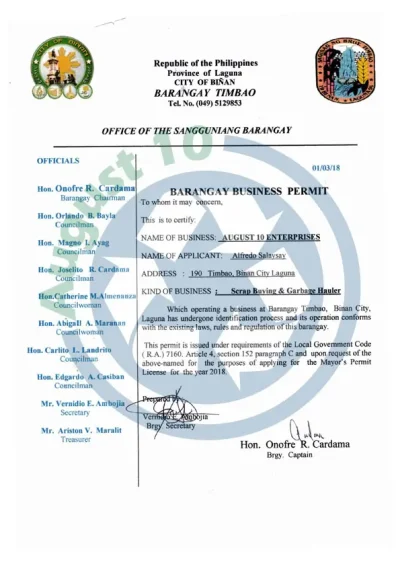

⚠️ Note: A barangay business permit is issued by your local barangay, not the city or municipal government. It is not the same as a Mayor’s Permit, which you still need to legally operate at the city level. This section only covers barangay-issued documents.
Barangay Business Permit FAQs
Here are answers to frequently asked questions about barangay business permits—clearing up confusion about their scope, limitations, and legal authority.
Q: Is barangay business permit enough to legally operate?
A: No, a barangay business permit is required but not sufficient on its own. It’s the first step in legalizing your business, but you also need to secure:
- A Mayor’s Permit (from your city or municipal hall)
- BIR Registration (for tax purposes)
- Other permits depending on your industry (e.g., DTI/SEC, sanitary, fire, etc.)
Without these additional documents, you are not fully compliant—even if you have a barangay clearance.
Q: Barangay Permit vs. Business Permit – What’s the Difference?
A: A barangay permit (also known as a barangay clearance) is a prerequisite for obtaining a Mayor’s Business Permit.
| Barangay Permit | Mayor’s Permit |
|---|---|
| Issued by the local barangay | Issued by the city or municipal hall |
| Confirms compliance with community rules | Confirms compliance with city-wide regulations |
| Needed to apply for Mayor’s Permit | Needed to operate legally at city level |
| Covers barangay-level validation only | Covers fire, health, zoning, tax, and business type |
In short, the barangay clearance is just one layer of legal business compliance.
Q: Can a barangay issue business permit?
A: Technically, barangays can issue a barangay business clearance, but not a full business permit. The authority to issue official business permits rests with the local government unit (LGU)—specifically the city or municipal licensing office.
However, for very small, home-based operations (like sari-sari stores), a barangay permit may be temporarily accepted for informal business activity. Still, it’s strongly recommended to proceed with full registration.
Q: What is the barangay ordinance for business permit?
A: Barangays operate under a Barangay Ordinance—a local law that outlines the rules for issuing permits, collecting fees, and enforcing compliance. This ordinance gives barangay officials the legal basis to:
- Require business clearances
- Conduct inspections
- Deny permits if zoning or safety guidelines are violated
- Collect community tax and processing fees
You may request a copy of your barangay’s specific ordinance for reference.
Q: What is the expiration of a barangay business permit?
A barangay business permit is typically valid for one calendar year—from January 1 to December 31. Regardless of the issue date, the permit expires at the end of the year.
For example, even if you get your clearance in July 2024, it will still expire on December 31, 2024.
To avoid penalties and disruptions, it’s recommended to renew your barangay business permit at least one month before the expiration date, usually by January 31 of the following year.
Special Cases
Not all businesses follow the same process. Below are special considerations for sari-sari stores, micro-enterprises, and DTI-registered businesses when applying for a barangay business permit.
Permits for Sari-Sari Stores & Micro-Businesses
Sari-sari stores and other micro-businesses are the most common applicants for barangay permits. Here’s what you need to know:
- A barangay business permit for sari sari store is typically simpler and cheaper to obtain. Requirements usually include a valid ID, lease proof (if rented), and DTI registration.
- Many barangays waive certain requirements for home-based or micro-enterprises, provided the business does not disturb neighbors or pose safety issues.
- Expect to pay around ₱300 to ₱600, depending on your barangay’s fee schedule.
For sari-sari stores, it’s still recommended to register with the DTI and obtain a Mayor’s Permit later if the business grows or begins issuing official receipts.
✅ Some barangays even have a dedicated barangay micro business permit category for very small-scale enterprises.
DTI Registration & Barangay Permits
Your DTI Certificate is a prerequisite for securing a barangay business permit for sole proprietorships. Here’s how the two are connected:
- The DTI barangay business permit pathway begins with getting your business name registered at bnrs.dti.gov.ph
- After registration, you must bring the DTI certificate to your barangay hall as part of your application documents
- Your business name must match exactly across the DTI certificate, barangay permit, and all other local government documents
DTI registration alone does not allow you to operate—you still need barangay, city, and BIR permits.
Pro Tips & Warnings
Staying compliant with your barangay business permit requirements doesn’t end after approval. Here are key tips to help you avoid penalties and maintain smooth operations:
✅ Display Your Barangay Business Permit Prominently
Once issued, post the original copy of your permit in a visible spot at your place of business—preferably near the entrance or counter. Some barangays conduct random inspections, and failure to display it can result in fines or temporary suspension.
⏰ Renew One Month Before Expiry
Don’t wait for the last day. Renew your barangay business permit at least 30 days before it expires (typically by January 31st each year). This gives you enough time to resolve any issues and avoid late renewal penalties.
🧾 Keep Official Receipts of Payment
Always request and keep the official receipt (OR) from your barangay hall when you pay your permit fees. These serve as proof of compliance and can be useful in resolving disputes or verifying renewal eligibility.
⚠️ Reminder: Non-renewal or failure to comply may result in your business being flagged as unregistered, affecting your ability to get a Mayor’s Permit or transact with banks and suppliers.